


Karambit Knife: Origins, History, and Uses of a Legendary Curved Blade
The karambit knife (also spelled kerambit) is instantly recognizable thanks to its distinctive tiger-claw-shaped blade. Originating in Southeast Asia, this curved knife evolved from a discreet agricultural tool into an iconic martial arts weapon before becoming a popular choice for self-defense, tactical applications, and Everyday Carry (EDC). This comprehensive guide explores the history, design, and modern uses of the karambit, providing everything you need to know about one of the world's most distinctive knife designs.
.jpg)
.jpg)
The Origins and History of the Karambit Knife
The karambit knife traces its origins to Indonesia, specifically the Minangkabau people of West Sumatra. The name derives from the Minangkabau words kurambik or karambiak, which roughly translate to "claw." According to local tradition, the knife's distinctive curved shape was inspired by the claws of the tiger (kuku macan or kuku harimau), an animal long admired for its strength, agility, and hunting prowess.
The earliest documented evidence of the karambit dates back to the 14th century, notably in a statue of King Adityawarman of Pagaruyung, believed to have been created between 1347 and 1375. Some historians, however, suggest that the design may have existed as early as the 11th century.
Originally, the karambit was a versatile agricultural tool used for a variety of everyday tasks, including gathering rice stalks, scraping roots, planting, and harvesting crops. Its curved blade made these jobs easier, while the characteristic finger ring at the end of the handle allowed the tool to remain securely attached to the user's finger, keeping both hands free when necessary.
Over time, this humble farming implement evolved into a concealed weapon of last resort. Within Pencak Silat, and particularly the Minangkabau Harimau (Tiger) style, the karambit became a highly respected weapon. For centuries, its use was often reserved for datuk (tribal elders) and experienced practitioners, who regarded it as both a practical tool and a symbol of martial skill.
.jpg)
.jpg)
Distinctive Features of the Karambit Knife
The karambit knife is instantly recognizable thanks to its unique and highly functional design. Its defining characteristics include:
-
A curved, claw-shaped blade, typically with a single cutting edge, although double-edged and partially serrated versions also exist.
-
A finger ring at the end of the handle, designed for the index finger or little finger, providing exceptional retention even in wet, sweaty, or high-stress conditions.
-
An ergonomic handle, commonly crafted from materials such as G10, Micarta, hardwood, or modern synthetic composites.
-
A compact size, with most personal-use models featuring a blade length between 5 and 10 cm (2 to 4 inches).
Today, the karambit is available in several configurations:
-
Traditional fixed-blade models, closely inspired by their Southeast Asian origins.
-
Modern folding karambits, which have become especially popular in Western countries.
-
Plain-edge blades for everyday cutting tasks.
-
Partially serrated versions designed for cutting fibrous materials such as rope or webbing.
-
Utility-oriented EDC models, intended for practical everyday use rather than martial applications.
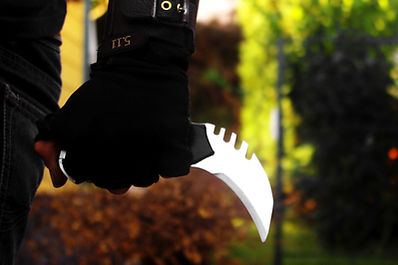
The traditional way to hold a karambit is in a reverse grip, with the blade extending from the little-finger side of the hand. This grip enables powerful slicing motions, hooking techniques, and fluid circular movements. The integrated finger ring not only improves control during manipulation but also greatly reduces the risk of accidentally dropping the knife.
.jpg)
_JPG.jpg)
Traditional Uses of the Karambit
Within Pencak Silat, the karambit is regarded as a highly specialized close-quarters weapon. Its curved blade is designed to facilitate hooking, controlled cutting motions, and weapon-retention techniques, making it particularly effective in the context of traditional martial arts. The knife's compact size also allows it to be carried discreetly.
Practitioners of Harimau Silat ("Tiger Style") employ the karambit using fluid, circular movements inspired by the agility and precision of a tiger. Historically, the karambit was often considered a weapon of last resort, intended for use only after primary weapons such as the kris or a spear had been lost or rendered unusable.
Modern Uses of the Karambit Knife
Today, the karambit knife serves a variety of purposes beyond its historical origins.
Martial Arts and Personal Defense
The karambit remains widely used in Pencak Silat, Filipino Kali/Eskrima, and certain modern self-defense systems. Its secure grip and distinctive curved blade have contributed to its reputation as an effective close-range tool when handled by trained practitioners.
Because of its unique design and handling characteristics, mastering a karambit requires dedicated training and proper instruction. Like any knife, it should be handled responsibly and in accordance with local laws.
.jpg)
.jpg)
The Karambit as an Everyday Carry (EDC) Knife
Many enthusiasts appreciate the karambit knife as an Everyday Carry (EDC) tool thanks to its compact size and distinctive blade geometry. Depending on the design and the user's experience, it can be well suited for a variety of routine cutting tasks, including:
-
Opening cardboard boxes
-
Cutting packaging materials
-
Slicing rope and cordage
-
Working with leather
-
Performing small, precise cutting tasks
Its unique curved blade can offer excellent control and efficiency for pull-cutting applications once the user is familiar with its handling characteristics.
Outdoor Applications
Some fixed-blade karambits are also used for outdoor activities such as:
-
Camping
-
Hiking
-
Light bushcraft
-
General camp and bivouac tasks
Their curved blade geometry is particularly effective for cutting techniques that rely on controlled pulling motions, making them a practical option for certain outdoor tasks.
.jpg)
.jpg)
Modern Materials Used in Karambit Knives
Modern karambit knives benefit from significant advances in metallurgy and materials engineering. Today's premium blades are often crafted from high-performance stainless and tool steels, including:
-
Elmax
-
Vanadis 4 Extra
-
Böhler N690
-
CPM S35VN
-
CPM S45VN
-
Böhler M390
-
MagnaCut
-
Sleipner
These modern steels offer an outstanding balance of edge retention, toughness, corrosion resistance, and ease of maintenance, making them well suited for both everyday use and demanding environments.
Handle materials have also evolved considerably and are available in a wide range of premium options, including:
-
Carbon fiber
-
G10
-
Micarta
-
Titanium
-
Stabilized wood
-
Exotic hardwoods
The choice of steel and handle material ultimately depends on the knife's intended purpose, whether for Everyday Carry (EDC), outdoor activities, collecting, or custom craftsmanship.

.jpg)
Fixed-Blade or Folding Karambit?
Choosing between a fixed-blade karambit and a folding karambit largely depends on your intended use.
A fixed-blade karambit offers several advantages:
-
Maximum strength and durability
-
Excellent ergonomics and handling
-
Simple maintenance with no moving parts
-
Requires a dedicated sheath for safe carry
A folding karambit provides a different set of benefits:
-
A more compact design
-
Easier and more discreet everyday carry
-
Convenient pocket or belt carry thanks to an integrated pocket clip
Both designs have their own strengths, and neither is inherently better than the other. The right choice ultimately depends on your personal preferences, intended application, and carrying style.
_JPG.jpg)
.jpg)
How to Maintain a Karambit Knife
Like any quality knife, a karambit deserves regular care to preserve its performance and appearance. Fortunately, proper maintenance requires only a few simple habits:
-
Clean the blade after each use.
-
Dry the knife thoroughly before storing it.
-
Apply a light coat of protective oil from time to time if the blade is made from a non-stainless steel.
-
Keep the edge properly sharpened to ensure optimal cutting performance.
With proper care and routine maintenance, a well-made karambit can provide reliable performance and remain in excellent condition for many years.
.jpg)
.jpg)
The Handmade Karambit Knife
While mass-produced karambits are widely available, the design is also highly appreciated within the world of custom knife making. Each craftsman can personalize numerous aspects of the knife, including:
-
The curvature of the blade
-
The blade thickness
-
The handle ergonomics
-
The choice of materials
-
The finishing details
The result is often a unique piece that combines functionality, craftsmanship, and aesthetics. Handmade karambit knives appeal not only to collectors but also to enthusiasts who appreciate finely crafted objects made with skill, precision, and attention to detail.
More than just a tool, a custom karambit can become a true expression of the maker's expertise and the owner's appreciation for exceptional craftsmanship.
.jpg)

Why Is the Karambit Knife So Fascinating?
The enduring popularity of the karambit knife can be explained by several unique characteristics. Its instantly recognizable silhouette gives it a strong visual identity, while its history, deeply rooted in the traditions of Southeast Asia, adds to its cultural appeal.
Beyond its distinctive appearance, the karambit's ergonomic design and versatility have made it highly appreciated by both knife enthusiasts and collectors. Its unique shape continues to inspire modern makers, who reinterpret this historic design through the use of advanced materials, innovative techniques, and increasingly refined craftsmanship.
Over the decades, the karambit has evolved into more than just a traditional knife design. It has become a symbol of creativity and craftsmanship, where heritage meets contemporary knife making.
.jpg)
.jpg)
Karambits with Spear-Point Blades
Spear-point blade karambits offer a more versatile approach compared to traditional karambit designs with strongly curved blades. Their blade profile provides a more balanced and practical cutting geometry, making them suitable for a wider range of everyday applications.
Another major advantage of the spear-point karambit is its ease of maintenance. Compared to a traditional curved karambit blade, the straighter edge geometry is significantly easier to sharpen and maintain, making it an appealing choice for users who appreciate the karambit's distinctive design while looking for a more practical everyday cutting tool.
.jpg)
.jpg)
Karambits with Tanto Blades
Similar to the spear-point karambit, the tanto blade karambit represents a more specialized interpretation of the traditional design. The reinforced tanto-style tip provides increased strength and durability, making it better suited for demanding cutting tasks and situations where a stronger point is beneficial.
This blade profile appeals to users who appreciate the distinctive ergonomics of a karambit while looking for a design that offers additional tip reinforcement and increased versatility in challenging environments.


Why Does the Karambit Remain Timeless?
The karambit knife perfectly embodies the evolution of a simple agricultural tool into a cultural icon with both historical and modern appeal. From its origins in Sumatra, to Silat martial arts traditions, and its place today among Western collectors and Everyday Carry (EDC) enthusiasts, the karambit has preserved its unique identity thanks to its distinctive shape inspired by nature.
A Knife Appreciated by Collectors
Over the years, the karambit has become a true collector's piece. Its striking silhouette gives custom makers the opportunity to fully express their creativity through the overall design, material selection, and finishing details.
Each handmade karambit carries its own personality, reflecting the craftsmanship and vision of its maker. For many enthusiasts, owning a custom karambit is about more than possessing a functional knife — it is also about appreciating a unique piece of knife artistry and craftsmanship.
.jpg)
.jpg)
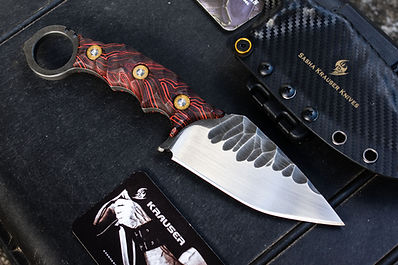
Handmade Karambit Knives by Sasha Krauser Knives
Every karambit knife created by Sasha Krauser Knives is entirely handcrafted, with meticulous attention given to every stage of the manufacturing process:
-
Selection of premium blade steels
-
Optimized heat treatment
-
Precision grinding and edge geometry
-
Careful hand fitting and finishing
The goal is to create a knife that combines elegant design, outstanding cutting performance, and exceptional craftsmanship.
➡️ Explore our collection of handmade karambit knives: Karambit List model
➡️ Discover our other handmade knives: Folding knives ; Fixed blades list 1 ; Fixed blades list 2
➡️ Discover the premium steels selected for our handcrafted knives : FAQs
.jpg)
.jpg)
Conclusion
The karambit knife is far more than a simple curved blade. As the heir to a rich Southeast Asian tradition, it perfectly represents the meeting point between history, ergonomics, and the art of knife making.
Even today, the karambit continues to inspire craftsmen around the world through its distinctive design and remarkable balance. Beyond its striking appearance, a true handmade karambit is defined above all by the quality of its construction, the precision of its execution, and the attention devoted to every detail.
This continuous pursuit of excellence is the philosophy that guides every creation made by Sasha Krauser Knives.


