


Knife Handles
Types, materials, finishes and how to choose the right handle
A knife handle is far more than a simple element that allows you to hold a blade. It is the interface between the user’s hand and the blade, and it plays an essential role in grip, comfort, safety, balance and the durability of the knife. It is what determines comfort, safety, grip in all conditions and the lifespan of the knife. Excellent steel poorly mounted on an unsuitable handle can quickly become a frustrating, even dangerous tool. Conversely, a well-designed handle turns a good knife into a reliable everyday companion, whether in the kitchen, for bushcraft or professional use.
In knifemaking, the choice of a handle therefore depends on many criteria: type of knife, intended use, ergonomics, environment, mechanical strength, maintenance, aesthetics and even the possibility of future repair or modification. Whether it is a kitchen knife, an outdoor knife, a hunting knife, an EDC knife or a handcrafted piece, the handle must be designed according to how the knife will be used, not solely for its appearance. In this article, we will look at the main types of knife handles, the materials used in knifemaking, the different finishes available and the criteria for choosing the most suitable handle for your knife.
.jpg)
.jpg)
Why is a knife handle so important?
The blade is obviously the element that does the cutting, but it is the handle that allows the user to control that blade. A poorly designed handle can make excellent steel much less pleasant to use. Conversely, a well-thought-out handle can transform the way a knife is used. Several parameters are directly involved.
Ergonomics
The shape of the handle must match the morphology of the hand and the intended use. A handle that is too thin may lack comfort during prolonged use. A handle that is too thick can reduce precision and tire the hand. Curves, angles, thickness and the different grip zones must therefore be carefully considered.
Safety
The hand must remain correctly positioned on the handle, even when conditions become less favourable. Depending on the type of knife, the geometry of the handle can help prevent the hand from sliding towards the edge. Surface texture also plays an important role, especially when the knife is used with wet hands or in outdoor conditions.
Blade control
The handle directly influences the precision of movements. A suitable handle makes it easier to control the orientation of the blade and to perform precise movements. This is particularly important for knives intended for fine cutting, craft work or certain outdoor uses.
Balance
The weight and geometry of the handle also influence the overall balance of the knife. A very light material such as certain composites will not produce the same balance as a dense material like titanium. There is no universal ideal balance, however. It depends on the type of knife and the user’s preferences.
.jpg)
.jpg)
The main types of knife handles
There are many handle constructions in knifemaking. Some are traditional, others come from modern manufacturing techniques. Here are the main ones.
Full tang construction
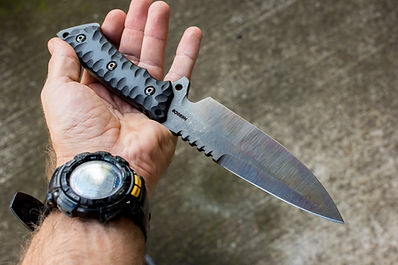
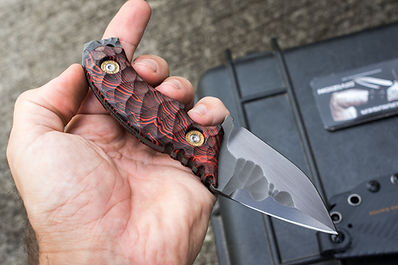
In a full tang construction, the tang of the blade runs through almost the entire length and width of the handle. Scales are then attached on each side of this structure. This construction is particularly appreciated for knives intended for demanding use. It provides a robust structure and good transmission of forces between the blade and the handle.
These scales can be made from many materials: wood, micarta, G10, carbon fibre, titanium, vulcanized fibre, composite materials.
Scales allow great freedom in the choice of shapes, colours and textures. They can also be replaced more easily on certain constructions.
.jpg)
.jpg)
Paracord handle
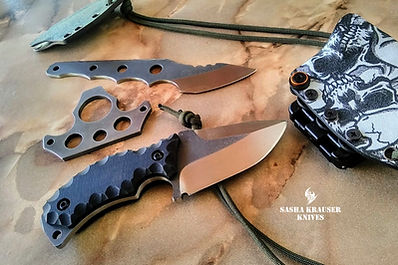
Paracord can also be used to form the covering of the handle. This solution is particularly appreciated on certain outdoor, bushcraft or survival knives. It offers several advantages: reduced weight, good grip, ease of replacement, many colour options, and the possibility of removing the cordage to use the paracord itself.
Paracord does not, however, provide exactly the same feel as a rigid handle. It can therefore be particularly interesting when lightness, simplicity and repairability are priorities.

Monobloc handle
Some knives are made from a single piece of material, particularly in certain metal constructions. The handle can then be machined directly from the material used for the structure of the knife. This approach produces a very solid and minimalist construction.

.jpg)
Materials used for knife handles
The handle material directly influences the weight, strength, grip, maintenance and appearance of the knife. There is therefore no universally superior material. The best choice depends on the intended use.
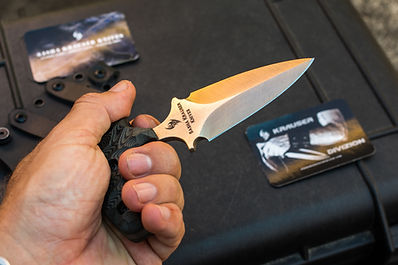
Micarta : A composite made from layers of fabric (linen, canvas, denim, jute, etc.) impregnated with phenolic resin and compressed under heat and pressure. Advantages: excellent grip (especially when wet), a warmer and more organic feel than G10, very strong, develops a nice patina over time, good shock absorption. Disadvantages: can absorb a little moisture and odours over the long term (less than wood), a little more expensive than G10. Ideal for: outdoor, bushcraft, hunting knives and intensive use.
.jpg)
.jpg)
G10 : A laminate of fibreglass fabric impregnated with epoxy resin, compressed under high pressure. Advantages: extremely robust, lightweight, virtually waterproof, highly resistant to impact, moisture and chemicals, excellent value for money, easy to texture. Disadvantages: colder feel than Micarta. Ideal for: tactical knives, intensive EDC, professional use and harsh conditions.
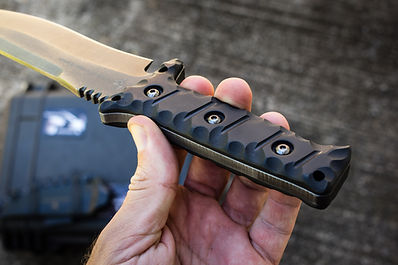.jpg)

Carbon fiber : fabrics impregnated with resin. Advantages: very light, high rigidity, modern and premium appearance, good mechanical strength. Disadvantages: more expensive, more brittle under localised impacts than G10 or Micarta. Ideal for: high-end lightweight knives, premium EDC, technical aesthetics.

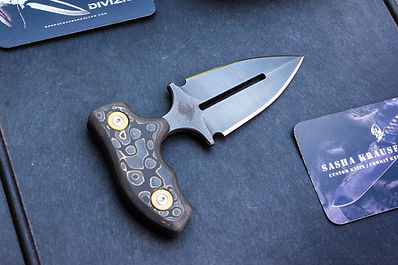
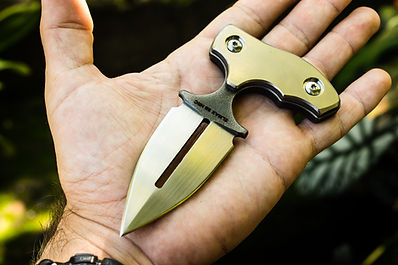
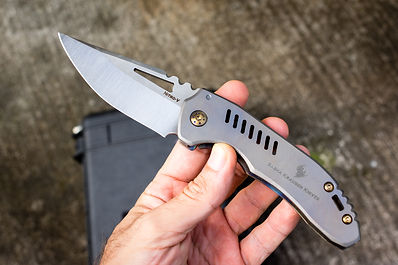
Titanium : A lightweight metal, highly resistant to corrosion, with an excellent strength-to-weight ratio. Advantages: extremely durable, almost zero corrosion, warmer feel than aluminium or steel (due to its thermal conductivity properties), possibility of anodising (colours), very strong. Disadvantages: high cost (material + machining), slippery grip if not textured, a little heavier than composites. Ideal for: high-end knives, frame-lock, premium use and collectors.
Why use titanium for a handle? Titanium makes it possible to create particularly robust handles while keeping a reasonable weight. Its very distinctive aesthetics also make it a sought-after material for high-end knives and handcrafted creations.
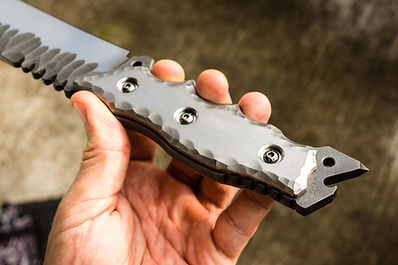.jpg)
.jpg)
Vulcanized fibre : A material based on compressed and chemically treated cellulose, resulting in a dense, horny and resistant material. Advantages: good rigidity, relative lightness, good machinability, interesting appearance, often used as liners (decorative and structural spacers) or in thin layers. Resists many solvents and oils well. Disadvantages: less common as a primary scale material than Micarta or G10; more fragile in greater thicknesses under repeated impacts. Ideal for: decorative and structural liners, multi-material handles, coloured accents or modernised traditional constructions.
Wood, natural materials and composite materials
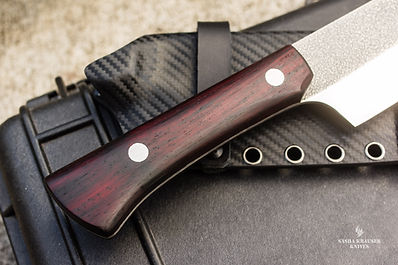
Even though composite and metal materials are very popular today, natural materials still hold an important place in artisanal knifemaking. Wood remains an emblematic material for knife handles. Depending on the species chosen, it can offer very different colours, grain patterns and feels. Other materials can also be used, including certain stabilised natural materials. The choice then depends as much on the desired technical characteristics as on the desire to create a unique piece.

.jpg)
The different finishes of a knife handle
The choice of material is only part of the equation. Surface finish has a huge influence on the feel in the hand. Two handles made from exactly the same material can give a completely different impression depending on their finish.
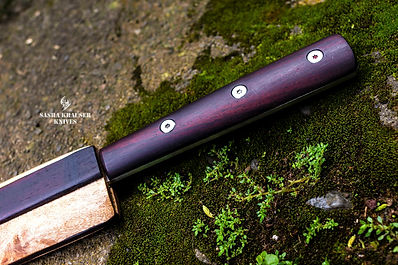
Smooth finish : A smooth surface is pleasant to the touch and can give the knife a particularly elegant appearance. It is generally less grippy than a textured surface, however. It can therefore be particularly interesting when tactile comfort and aesthetics are priorities.
.jpg)
_JPG.jpg)
Satin or bead-blasted finish : A satin or bead-blasted finish produces a less shiny and often more uniform surface. It generally gives a more technical and discreet look. On certain materials, this finish can also noticeably change the feel of the handle.
.jpg)
.jpg)
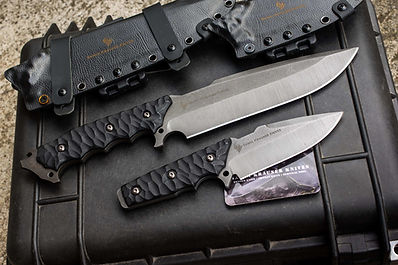
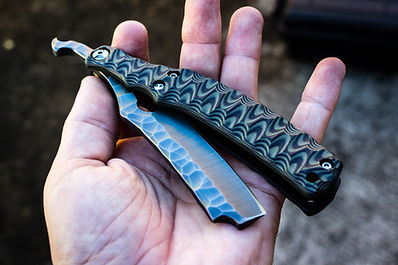
Texturing / toxification / stippling : Texturing consists of deliberately creating a surface with more relief. Its main purpose is usually to improve grip. It can take many forms: grooves, cross-hatching, geometric patterns, milling, mechanical textures. The texture must nevertheless remain consistent with the intended use. An extremely aggressive surface can improve grip but become uncomfortable during prolonged use.
.jpg)
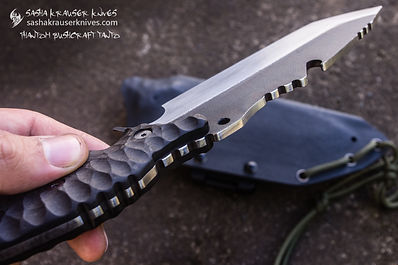
Jimping and contact zones : Certain areas of the handle can also receive grooves or patterns designed to improve control. These elements are particularly useful when several grip positions are intended. They can also contribute to the aesthetic identity of the knife.
.jpg)
.jpg)
How to choose the ideal handle for your knife?
The best handle is not necessarily the most expensive, the most exotic or the most spectacular. It must above all be suited to the intended use. Here are the main criteria to consider.
-
Define the knife’s use
Start by determining how the knife will be used. A kitchen knife will not have the same needs as a hiking knife. A knife intended for outdoor use may prioritise moisture resistance and grip. A collector’s knife may place more emphasis on aesthetics and finish.
-
Take the environment into account
The environment of use is decisive. For wet or marine use, it may be interesting to prioritise materials that are particularly resistant to moisture and corrosion. For a knife intended to be used in cold conditions, the feel of the material in the hand can also become an important criterion.
-
Choose the level of grip
A very smooth surface can be pleasant but less grippy. A heavily textured surface generally offers more grip. The right balance between comfort and grip must therefore be found.
-
Consider the weight
The weight of the handle directly influences the total weight of the knife and its balance. G10, micarta and carbon fibre in particular make it possible to produce relatively light handles. Titanium offers an excellent compromise between mass, strength and rigidity.
-
Think about maintenance
A knife intended for daily use does not necessarily require the same level of maintenance as a collector’s piece. Synthetic and composite materials are generally easy to maintain. Natural materials may require more attention depending on their nature and finish.

Screwed or glued handle: which to choose?
The attachment of the scales is an aspect sometimes overlooked when choosing a knife. Yet it can have a considerable impact on the lifespan and the possibility of evolving the knife.
Two main approaches exist in particular: gluing and mechanical fastening.
The glued handle
Gluing produces a clean construction and can be perfectly reliable when properly done. It is used in many traditional and modern constructions. However, when a scale is permanently glued, replacing it can become much more complex. A repair may then require removing the existing material and rebuilding the handle.
The screwed handle
With a screwed construction, the scales are held mechanically by screws and fastening elements. This solution has a particularly interesting advantage: the possibility of disassembling the handle. This can facilitate: maintenance, repair, replacement of a scale, customisation, modification of the ergonomics, change of material. For a knife intended to be used for many years, this possibility can represent a real advantage.
My preference as a knifemaker: screwed handles
As a knifemaker, I personally favour screwed handles whenever the design of the knife allows it. This choice is not purely aesthetic. I believe a knife should be able to continue evolving with its owner. A screwed handle facilitates repairability and makes it easier to consider changing the scales or restoring the knife several years after manufacture. This design also offers more freedom when an owner wishes to modify the appearance or feel of their knife. Finally, in certain designs it is possible to remove the scales and temporarily or permanently replace the handle with a paracord wrap. For me, a knife should not be designed only for the day it leaves the workshop, but for the years that follow. The ability to disassemble, repair, maintain and possibly modify the handle is an integral part of its longevity.
.jpg)
.jpg)
Which material to choose for your handle?
here is no universal answer, but here is a quick summary:


